Vinkyl, vinlagringsskåp eller vinrum? – Vad ska jag välja?

Aging wine – What is important?

If you have bought some fine wines that you love you will obviously want to store them in the best way, so that they reach the peak of their potential when you enjoy them. We are therefore going to go through the basic theory of what is important when aging wine. For more practical tips on how to achieve a favourable aging environment we recommend reading our articles on how to build a wine cellar.

Aging wine is based on what we call the five golden rules. There are obviously other things to take into consideration, but these five parameters are the ones that have greatest effect.

Correct temperature

Aging your wine at the correct temperature is an important factor for the wine to develop properly. The concept of the correct temperature not only means that the temperature should be at the right level, but also that it should be constant. A temperature that fluctuates (e.g. in a storeroom outdoors or a poorly insulated cellar) is bad both for the wine and the cork, whereby a basic prerequisite is that you want to have the same temperature all year round when you age wine.

12 degrees is a temperature level that is good for the wine. A few degrees below or over will not ruin the wine, the most important thing is to keep it within a span of 10-14 degrees and that the temperature stays constant.

Contrary to what many people think, all types of wine should be stored at the same temperature. Red and white wine is stored at the same temperature, even if the recommended serving temperature can differ considerably. A red wine needs to be taken out much earlier, while you might have to put a white wine in the fridge before drinking it.

What happens when you age wine at the wrong temperature? A high temperature is most detrimental, since it leads to chemical processes that affect the taste of the wine. If the temperature is too low this can also affect the taste, but will mainly lead to stopping the process of maturing.

Humidity

The humidity in the aging environment does not affect the actual wine, but rather the cork and the label. A high level of humidity is not detrimental for the wine, but it ruins the label and this is both unfortunate and impractical. When the humidity is too low the wine dries out, which causes air to come in contact with the wine and leads to an oxidation process. To prevent this the humidity should lie around 75%.

Humidity is also the reason why you should store your bottles horizontally. This causes the cork to come in contact with the liquid inside, which reduces the risk of drying out.

This is the basis for all aging of wine. If we were to choose the factors we consider to be most important it would be temperature and light.

As usual it is a matter of finding an aging solution that is both practical and beneficial. You might not want to have to go too far to collect your wines, or have a room that feels safer than another, in which case it is a question of compromising and being creative.

Vibrations

Vibrations also have a negative effect on the process of maturing. Vibrations can in fact be used to speed up the process of maturing, but it often leads to a deterioration of the quality of the wine. In an aging environment it is therefore something that you definitely want to avoid.

Light

Just like people, wine is affected by ultraviolet light. It is the rays of light that cause the grapes to mature when growing on the vines, and the effect is the same when they have been refined to wine. The result is that the wine matures too quickly and uncontrollably, and that the wine looses its balance. The solution to this problem is to store your wines in a completely dark environment, or with a glass door that has UV protection.

Oudor

Odour in contact with wine bottles can also cause the wine to assume the quality of the surrounding air. It is very difficult for air to penetrate through the glass wall of the bottle, but is easier through the cork, especially when the cork has dried up as a result of low humidity or temperature. The wine can be affected by this odour, and the problem is obviously greater the more pungent the odour is.

The basic rule is not to store your wine near anything with a strong smell. If your wine cooler or wine cellar has a carbon filter you get extra protection and constant air purification to ensure an odourless environment.

Build a wine cellar for your wine collection

Wine cellar – All you need to know

If you are very interested in wines, a wine cellar is one of the greatest projects you can embark on. Your wines get an optimum aging environment, while you get a beautiful and nice room where you have plenty of space to organise and enjoy your best wines. Nevertheless building a wine cellar is a project that requires planning and preparation, which we will do our best to prepare you for in this article.

Once you have made a decision that you want to have a wine cellar you have a first big choice to make; are you going to build it yourself, or have it built by an external party? If you are practical there are obviously many parties that you can turn to for help without having to lift a finger yourself (Google or contact us for tips), and if you are handy it can be fun and economical to build it yourself. Regardless of this we hope this guide will help you to take the next step in your project.

This article is arranged in five sections, which are:

It is also worth thinking about whether you do want a wine cellar, or if you should invest in a wine cabinet instead, which is worth thinking about one more time before starting your wine cellar project.


1. Why should you have a wine cellar?

If you are interested in wine no further motivation is needed for this question, but above all the obvious purpose of a wine cellar is that the wine should be good, and therefore we can start by going through the basics of aging wine , since this forms the basis for how the wine cellar should be built.

There are five basic components to fulfil for a wine to age well:

If the wine is aged in these conditions it will have its most optimal maturing process, and therefore the wine cellar will be built to fulfil these criteria. The first step in the process will be to find a suitable place.


2. Where should you have a wine cellar?

Finding a suitable place for a wine cellar obviously depends on your opportunities. If you are building a new house you have a lot to choose from, although most people are in the situation where they have to demolish a cloakroom, or rebuild a storeroom etc.

In practice it is often about finding a compromise between having fully optimal prerequisites for the wine and finding a suitable solution. Having your wine cellar under the stairs can be very nice, but since people go up and down the stairs it is not optimal from a vibration perspective. You quite simply have to decide what you think is most important.

As a wine cellar would imply, a cellar is in fact often a very good alternative because cellars are usually naturally cool and protected from light. But give it some good thought when thinking about where to locate the wine cellar. Some people are so creative that they rebuild an old sauna to make a wine cellar, since they get a lot of the preliminary work into the bargain. Only your imagination sets the limits.

Regardless of which room you choose there are above all two factors that you will need to take into consideration:

  1. That there is the possibility of exhaust air. Further on in this guide we will go through the different components that are needed in a wine cellar, and the essence of these components is the cooler. When the cooler is cooling it must have somewhere to press out the warm air that is “left over”. Outdoors is excellent, but a large adjacent room also works well. A small room such as a cloakroom or cleaning cupboard is not recommended, since the small space will quickly get hot and will impede the functionality of the cooler.
  2. That there is electricity. The cooler runs on electricity and therefore this is a must. You will probably also want to have a light in your wine cellar.

The above factors can be considered to be the only musts. You will also save on some of the running costs if you put your wine cellar in a place that is normally around 12 degrees, but this is a preference rather than a rule.

3. How big should a wine cellar be?

You should take into consideration the space that is actually available, but there are several other factors to think about to find your optimum size. If you have the privilege of being able to decide the size yourself, one tip is to design the wine cellar for at least twice the size of the collection of wines you have today. Your interest in wine is hardly going to diminish once you have a wine cellar, so it will be good to have some space.

On the other hand a large wine cellar needs more looking after. It needs a bigger cooler and better ventilation to ensure a uniform temperature. Apart from the actual construction there are also the running costs in the form of electricity, which nevertheless can be considered to be relatively low in this context.

Putting a figure on this is not easy, since every wine cellar is unique. As a general rule you could say that you need at least 3 square metres to have a collection of 500 bottles. If you want to have 1500 bottles you will need to go up to about 10 square metres. Take these figures as very general guidelines since the equation is obviously more complicated in reality. For example, the wall space is a lot more important than the floor space, and the way you arrange the interior fittings will also determine how many bottles you can find space for.

4. How do you build a wine cellar?

We will not go into exactly how to build a wine cellar, but we can list the steps you have to go through from start to finish.

  1. Think through the entire project from start to finish, and choose a room. Because you are reading this text you are apparently half way there, but it can be worth mentioning once again that planning and preparations will considerably improve the end result of your project. Measuring the temperature in the room (bear in mind fluctuations from summer to winter) gives you an idea of the size of cooler you will need.
  2. Insulate the room, both for moisture and the cold. How much insulation you need will depend a lot on your other prerequisites. A separate article could well be written on insulation and there are lots of different opinions on how insulation is best done, but in this article we have chosen not to go into insulation in depth and to focus on the general aspects instead.
  3. Make space for the cooler. Route cables for electricity and lighting.
  4. Put the interior fittings you have thought to have in place in the form of wine racks. There are a lot of opportunities for combinations here and we will be going through this in more detail in the next section.
 

5. Which components are needed in a wine cellar?

A wine cellar actually consists of a small number of components and we will start with the most essential, namely the cooler.

Cooler

The basic principle for a cooler for a wine cellar is that it is the same as for other types of coolers for refrigerators, air conditioners or heat exchangers, i.e. cooling is achieved by transporting heat to another place. The design of specialised wine cellar coolers (as opposed to standard air conditioning) is, however, optimised to maintain a temperature of 10 degrees as effectively as possible without drying out the air too much. The humidity is an important parameter in a wine cellar (it should be between 50 and 80%), so check that the cooler you choose can also handle the humidity. There are basically two types of coolers to choose between: Through-the-wall cooler or split system.

The big difference between the two systems is that in a ventilated system the actual cooler is somewhere else and the air flows into the room through a ventilation tube. In other words it works in accordance with the same principle as central air conditioning in a house. The advantage for your wine cellar is that you do not need to have the cooler in the actual cellar, just intake air, although the installation is a lot more complicated and takes more energy to run.

In a system that is not based on ventilation the cooler is placed inside the wine cooler and therefore does not need any ventilation tubes, whereby the warm and cold parts of the cooler are linked together by refrigerant tubes, which are much smaller than ventilation tubes. This is much simpler and so the only reason to choose a ventilated system is to reduce the noise somewhat and to avoid the aesthetic impact of having the cooler in the actual wine cellar.

Split system

The basic principle for a split system is the same as for a through-the-wall cooler, with the difference that the cooler is divided into two parts. An evaporator part that emits cold air and a condenser part that in turn emits warm air, which are linked together with tubes for the refrigerant. You put the cold part in your wine cellar, the warm part where you want to have your exhaust air, and then put the tubes in between. (This is very similar to how a heat exchanger works.) A split system is a good solution if you do not have a directly adjacent room where you want to have the exhaust air. A split cooling system also has the advantage that is reduces the noise and vibrations in the actual wine cellar, in that the insert with the compressor stands in a different room. On the downside these systems are much more expensive than a simple cooler.

Split systems can in turn be divided into two types of systems, namely ducted or ductless systems).

Through-the-wall cooler

This is the simplest and cheapest solution for a cooler and is therefore also the most popular solution. It is quite simply a cooler that you put in the wall, so that one side goes into the wine cellar and the other side out to the room you want to move the warm air to. The cooler will generate cooling in the wine cellar and the corresponding amount of warmth to the outside.

There are coolers for different sizes of wine cellars, where the manufacturer often indicates how many square metres the cooler can cool. Note that the insulation in your wine cellar will be decisive for how much the cooler needs to work, you can save a lot of energy by having a well insulated room.

Door

The choice of door should not be underestimated, above all since you can waste a lot of energy if you choose the wrong door. Just as the walls, floor and roof need to insulated, so does the door to prevent it leaking too much warmth. Doors for indoor use are in general not well insulated, while outside doors generally are. There are also special doors made for wine cellars, which can be more aesthetically attractive than a normal outside door, even if they are functionally similar to an outside door.

Wine rack

The wine rack is the essence of the actual interior of the wine cellar and is obviously of central importance both functionally and in terms of appearance. There are almost an infinite number of ways in which you can fit out your wine cellar, but your first decision will be whether you want to go for a less expensive and more standardised solution, or a more expensive custom-made solution. A specially built solution (which means a joiner builds it from scratch) is obviously much more expensive, but gives you precisely the look you want to have.

If you choose instead to buy finished modules, there are a host of manufacturers to choose from. There are basically three different types of wine racks that are common in a wine cellar:

Cross shaped modules

This module is best described as a horizontal case with a cross in it. In this way bottles can be placed on each other in the compartments. This is a popular and nice solution if you want to have space for a relatively large number of bottles. The disadvantage is obviously that it is more difficult to take out an individual bottle. (There are cross solutions where the compartments have different sizes, and also for where each bottle has its own compartment.)

Individual stacking

Each wine bottle has its own compartment. The advantage of this is obviously the simplicity of easily taking out one bottle. The disadvantage is that it is not the most space-saving and that there are different sizes of bottles. A wine cellar often has a large number of these types of compartments.

Case storage

Case storage involves compartments or shelves where you can store wines in their wine cases, which is optimal if you want to retain the actual cases.

Usually a mix of different modules is what is most attractive and most effective in a wine cellar, and by searching Google you can find lots of inspiration.

Some other points are worth thinking about when it comes to wine racks:

  • Which type of wood should I use? The most important thing is that the wood you use does not mould or emit odour. Common materials for wine racks are oak or pine, while more exclusive racks are made from mahogany or walnut.
  • Note that there is a big difference in size between different types of bottles. Choose somewhat different types of storage modules for this reason. Most types of bottles, even champagne (not magnum bottles), can manage with a hole that is 10 cm, whereby this is good guideline.

Last, but not least…

Do you need to follow all these tips to the letter?

Of course not, the most important thing is that you get a solution that you are pleased with. Perhaps you have limited space, perhaps you prioritise being able to see your bottles, that they are fully protected from sunlight, and perhaps that you do not want to invest in a cooler. You decide what suits you best, and if you should have any queries, viewpoints or thoughts you are naturally more than welcome to contact us.

Design tips:

  • Many wine cellars look good by having natural materials. Think stone, brick and wood. You can also have a plant, some wine accessories or pictures to enhance the feeling.
  • A cooler is often not very pretty, so if you can conceal it in the structure it would be preferable. The priority of course is that it sits in a functional place.
  • The lighting can radically enhance the experience of a wine cellar. Dimmable spotlights in the right place will do wonders for your wine cellar.

General tips:

  • Take into account that your wine is liable to be stolen. There are doors with locks, but depending on the position of the wine cellar there can be other ways of getting in, such as a window.
  • All wine is stored at the same temperature. But if you want to have a few bottles ready at serving temperature you can add a small 2-zone wine cooler in the kitchen.
  • And finally, don’t forget to also drink your wine! Storage is the journey, drinking it up is the goal!
vinkylstest-2020-inbyggbara-vinkylar.jpg

Test Built-in Wine Coolers 2020 – We compare different models and brands

vinkylstest-2020-inbyggbara-vinkylar.jpg

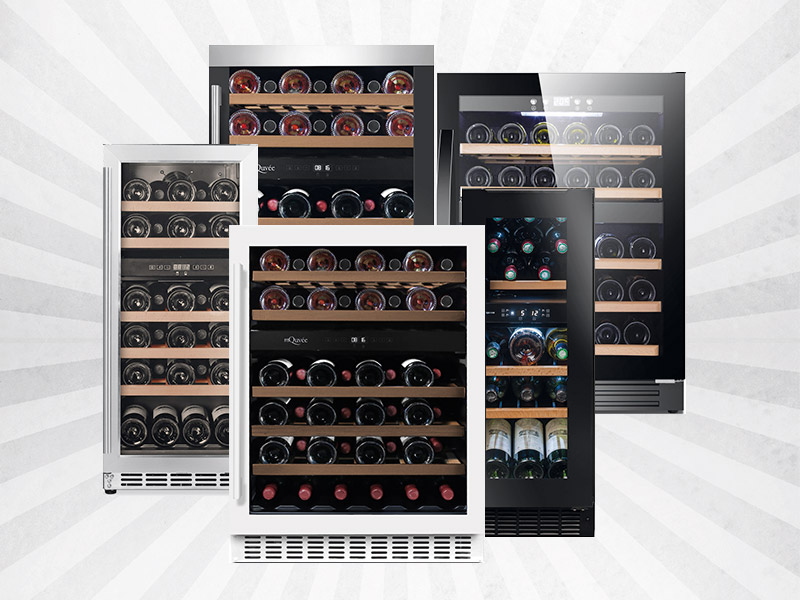
Are you looking for a new wine cooler, but are unsure which one matches your requirements? No problem – continue reading and we will help you to find the right one! In this article we compare built-in wine coolers from the brands Avintage, Cavin and mQuvée. To make your choice as easy as possible we have with the help of the judgment of our customers presented five popular built-in wine coolers with different functions, capacity and design.

Before buying a wine cooler it can be difficult to know what to look out for. If you are unsure about what it is important to think about you can read our buying guide.

Avintage Inbyggbar vinkyl - AVU18TDZA

1. Avintage Built-in wine cooler – AVU18TDZA

– Price: £849
– Energy class: A
– Capacity: 17 bottles

This smaller wine cooler from Avintage has an innovative design with a glass door in black piano varnish and an inset handle. On 3 pull-out shelves the wine cooler has a capacity for 17 wine bottles, which makes this model very affordable according to our customers. With a width of 29.5 cm and a height of 82/88.5 cm the unit is easily built-in under the kitchen counter to make a success of your kitchen!

This wine cooler suits you if: You want to cool a small number of bottles and are looking for a built-in model, with a high standard at a bargain price.

Avintage is Climadiff’s premium collection that offers both wine cabinets and built-in wine coolers with the latest technical innovations. The collection has a stylish and robust design that offers both black and stainless wine coolers. You can read more about Avintage and click home your favourite at Winestoragecompany.co.uk.

Good attributes:

Minor attributes:

mQuvée Inbyggbar vinkyl - WineCave 700 50D Modern

2. mQuvée Built-in wine cooler – WineCave 700 50D Modern

– Price: £899
– Energy class: A
– Capacity: 38 bottles

mQuvée’s WineCave 700 50D Modern has a door in a combined black and stainless finish that gives an extra touch to your home. With a width of 50 cm this wine cooler is unique on the market and can be either built-in or used free-standing. This elegant and multifunctional wine cooler produces outstanding customer reviews and is judged to live up to what it promises!

This wine cooler suits you if: You are looking for a somewhat more exclusive unit that guarantees you get what you are paying for. The WineCave model is ideal if you want to have all the necessary functions and more besides, and if you are ready to go beyond the safety zone in terms of design.

mQuvée is a brand specialising in wine and its storage. The functionality that permeates all their units means that they are equipped with UV protected glass doors, compressor cooling and wooden shelves. The majority of built-in wine coolers also have 2 temperature zones that permit you to store both white and red wines in the same cooler. Read more about mQuvée’s WineCave 700 50D and click it home at Winestoragecompany.co.uk

Good attributes:

Minor attributes:

mQuvée Inbyggbar vinkyl - WineCave 60D Powder White

3. mQuvée Built-in wine cooler – WineCave 60D Powder White

– Price: £999
– Energy class: A
– Capacity: 45 bottles

mQuvée’s other bestseller comes in a mat white design adjusted in size for the Scandinavian market. WineCave 60D has a seamless door with a width of 59.5 cm and an adjustable height up to 89 cm. With mQuvée’s first-class features in the form of a carbon filter, touch control panel and digital display, this wine cooler belongs to a higher price class.

This wine cooler suits you if: You are looking for a model with a stylish, solid design that works in all circumstances. This wine cooler is ideal if you are willing to spend a bit more in favour of an exclusive model with all the best functions.

mQuvée is a brand specialising in wine and its storage. The functionality that permeates all their units means that they are equipped with UV protected glass doors, compressor cooling and wooden shelves. The majority of built-in wine coolers also have 2 temperature zones that permit you to store both white and red wines in the same cooler. WineCave 60D comes in several different sizes and colours – you will find more information at Winestoragecompany.co.uk

Good attributes:

Minor attributes:

Cavin Inbyggbar vinkyl - Scandinavian Collection 800 Stainless

4. Cavin Built-in wine cooler – Scandinavian Collection 800 Stainless

– Price: £729
– Energy class: A
– Capacity: 29 bottles

This affordable model from Cavin has a door height of 800 mm, which is perfect if you for example have a kitchen from IKEA. The wine cooler has a protective anti-vibration system, compressor cooling and a touch control panel that make it optimal for winter storage and also easy to adjust. With an adjustable height of up to 92.5 cm, this is one of our higher models with a stainless design that just cannot go wrong.

This wine cooler suits you if: You are looking for a somewhat less expensive, but functional wine cooler to build-in under the kitchen counter. The wine cooler has a limited capacity of 29 bottles, optimal if you are a beginner and do not want to cool too much at once.

You can read more about the wine cooler and click it home at Winestoragecompany.co.uk.

Good attributes:

Minor attributes:

Cavin Inbyggbar vinkyl - Scandinavian Collection 40 Fullglass Black

5. Cavin Built-in wine cooler – Scandinavian Collection 40 Fullglass Black

– Price: £759
– Energy class: A
– Capacity: 40 bottles

This modern wine cooler from Cavin’s Scandinavian Collection has a capacity for up to a total of 40 bottles! With two temperature zones and pull-out wooden shelves, this unit creates the perfect conditions for cooling your wine nicely and effectively. The wine cooler has a width of 59.5 cm and an adjustable height of 82/88 cm. According to the judgement of customers it is both quiet and very easy to install!

This wine cooler suits you if: You are looking for a wine cooler with lots of capacity – perfect if you want to cool many bottles of wine, but are not looking for more that what is necessary.

Good attributes

Minor attributes:

Test Free-standing Wine Coolers 2020 – We compare different models and brands

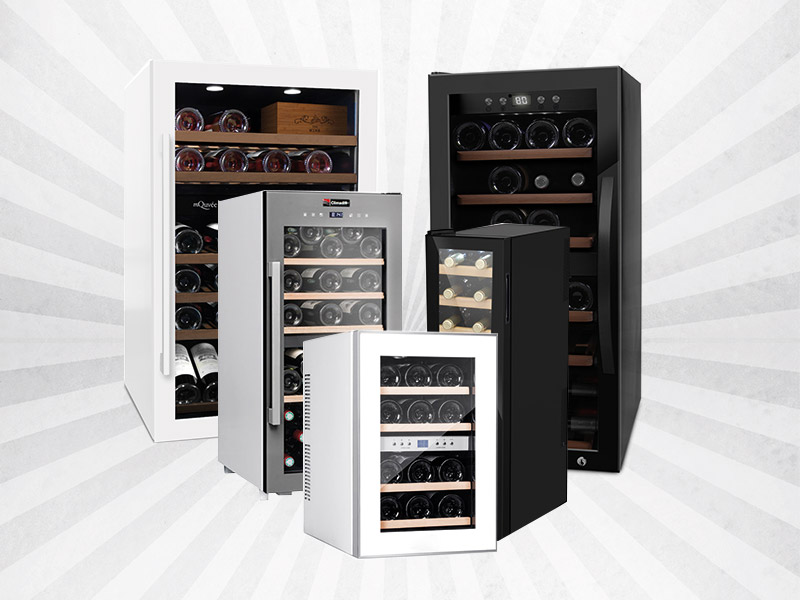
Are you looking for a new wine cooler, but are not sure which is the best choice? We are helping you here to find the ultimate wine cooler by looking more closely at models from the Cavin, Climadiff and mQuvée brands. To make your choice easier we compare wine coolers on the basis of function, capacity and design, with both our own expertise and the reviews and judgements of customers.

Before buying a wine cooler it can be difficult to know what to look out for. If you are unsure about what it is important to think about you can read our buying guide here.

1. Cavin Free-standing wine cooler – Northern Collection 12

– Price: £299
– Energy class: B
– Capacity: 12 bottles

This wine cooler is the latest from Cavin and comes in an all-white design with pull-out wooden shelves. With a height of 54 cm and a width of 34.5 cm, Northern Collection 12 is a big favourite if you prefer to cool a smaller number of bottles before serving. With its pull-out wooden shelves, LED lighting and thermoelectric cooling, this wine cooler meets every basic requirement.

This wine cooler suits you if: You are looking for a smaller wine cooler at an affordable price. Perfect to place on smaller surfaces, such as the kitchen counter.

Good attributes:

Minor attributes:

2. Cavin Free-standing wine cooler – Northern Collection 16

– Price: £279
– Energy class: B
– Capacity: 16 bottles

This thermoelectric wine cooler from Cavin comes in a slimmer design with a width of 25.2 cm and a height of 84 cm. The wine cooler has thermoelectric cooling, which gives it a low vibration level. It also comes with wooden shelves, LED lighting and a thermometer with a digital display. If you are looking for a luxurious wine cooler with a good standard at a lower price, you have found a good match in Cavin’s Northern Collection 16.

This wine cooler suits you if: You are looking for a slimmer, luxurious design in the lower price class. The wine cooler has electronic control and touch screen if you are looking for that little extra.

Good attributes

Minor attributes:

3. mQuvée Free-standing wine cooler
– WineExpert 24 Fullglass Black

– Price: £449
– Energy class: A
– Capacity: 24 bottles

mQuvée’s bestseller WineExpert 24 has taken the market by storm and offers an energy-saving wine cooler with a stylish design! This wine cooler has a UV protected glass door and 2 adjustable temperature zones that allow you to store your wines in the best possible way. With its A marking, WineExpert 24 is both eco-friendly and energy-saving, which makes it a model our customers find difficult to beat! The wine cooler has a height of 88 cm and a width of 39.5 cm, which makes it neither too large nor too small.

This wine cooler suits you if:

 You are looking for a classic bestseller. This model is perfect if you are a beginner when it comes to collecting wines and want to have a wine cooler that keeps what it promises. mQuvée is a brand specialising in wine and its storage. The functionality that permeates all their units means that they are equipped with UV protected glass doors, compressor cooling and wooden shelves. mQuvée’s WineExpert is also available in Stainless and comes in several sizes with different capacities. 

You can read more about the wine cooler and click it home at Winestoragecompany.co.uk.

Good attributes:

Mindre bra egenskaper:

4. mQuvée Free-standing wine cooler – WineServe 59 Powder White

– Price: £799
– Energy class: A
– Capacity: 57 bottles

The wine cooler WineServe 59 is mQuvée’s high-class bestseller in a mat white design! The wine cooler has an effective carbon filter that keeps unwanted odour at bay and an elegant display shelf that gives it that little extra. With a height of 88.5 cm and a width of 54.5 cm this is one of the larger units and the ultimate choice for cooling a lot of bottles. With its UV protected glass door and compressor cooling, this unit has everything you could need and is therefore in the upper price class.

This wine cooler suits you if:

You are looking for a somewhat larger wine cooler with maximum capacity. The wine cooler is perfect for wine enthusiasts who want to have space for more bottles and are ready to spend that little extra for a top class cooler. mQuvée is a brand specialising in wine and its storage. The functionality that permeates all their units means that they are equipped with UV protected glass doors, compressor cooling and wooden shelves. mQuvée’s WineServe is also available in Stainless and in three different sizes, all of which have a carbon filter and energy class A. 

You can read more about the wine cooler and click it home at Winestoragecompany.co.uk

Good attributes:

Minor attributes:

5. Climadiff Free-standing wine cooler – CLS41MT

– Price: –
– Energy class: A
– Capacity: 41 bottles

The latest from Climadiff, CLS41MT, has a design that stands out and is controlled electronically. With a UV protected glass door and an effective anti-vibration system, this unit gives your wine bottles an ultimate storage. The wine cooler has a width of 40 cm and a height of 85.5 cm. The combination of the highest energy class and a capacity of 41 bottles makes this wine cooler one of the most affordable on the market.

This wine cooler suits you if:

You are looking for a modern wine cooler with a bolder design. The wine cooler is in the medium price class and is ideal if you are a beginner, but will still cool a large number of bottles. 

Climadiff is a well-known brand in France and has had experience in the aging of wine since 1997. The brand offers a wide specialist range of both wine coolers and wine cabinets.

Good attributes:

Minor attributes:

Wine cooler – All you need to know about your purchase!

Are you thinking about buying a wine cooler? Or perhaps a wine cabinet? What is actually the difference between them? And what is actually the difference in serving temperatures and aging temperatures when talking about wine? 

In this guide we have listed what you need to know before buying a wine cooler or a wine cabinet. Whether you want to age wine or store wine, there are different variants of wine coolers and wine cabinets to suit just what you need. In this guide we give you advice and tips so that you can make the best well-considered purchase.

The guide teaches you:

To store or age wine – wine cooler or wine cabinet?

Looking after your wines is becoming ever more popular and there is a lot to gain by storing and aging your wines in the right way. In addition to a functional advantage, it is also an interior furnishing that can enhance an entire room. When you store your wines separately from other foodstuffs you also protect it from odours and unnecessary vibrations, which in turn can ruin your wine and its quality.


The purpose of a wine cooler is to store your wines at the required temperature so that they are always ready to be served. In order to offer the best possible temperature for your wine collection there are wine coolers with from one to three adjustable temperature zones. If you only want to store and serve one type of wine, a wine cooler with one temperature zone is recommended. If you want instead to serve both red and white wine at the right serving temperatures, a wine cooler with two temperature zones is the best alternative. There are also wine coolers with three temperature zones, which provide space for both red and white wine, and also champagne. Look for a wine cooler with a DualZone or Multizone label if you want at least two temperature zones.

If on the other hand you want to store your wines for a longer time, a wine cabinet is the right choice for you. A wine cabinet offers an environment similar to a wine cellar, with optimum conditions for longer storage of wine. A wine cabinet maintains a temperature of 12 degrees, which is the perfect aging temperature for all types of wines. The environment and the function and format of the wine cabinet are also based on the five golden rules for aging wine – constant temperature, no vibrations, no light, no odour and a suitable humidity.

Now you are perhaps thinking that you would like to have both a wine cooler and a wine cabinet? You are not alone in this, and that’s why there is a multifunctional wine cabinet. A multifunctional wine cabinet has both cool and warm spaces for serving, while also providing the right conditions for aging wine. This alternative is popular with restaurant owners, since it allows them to both age and serve their wine collection.

The right size of wine cooler

The main things to think about when it comes to the choice of size are capacity, space and function.

Capacity: When talking about capacity you have to think about how big the wine collection is to know how big the wine cooler should be. Or in other words, how many bottles do you have? Does the purchase of a wine cooler or wine cabinet mean that you will be increasing your collection? For a wine cooler to function optimally it should be filled to at least 75 per cent of its capacity. This is because the bottles of wine help the cooler to maintain the right temperature, and that it needs bottles to work with for optimum functionality.


When thinking about capacity, you should also consider what your bottles look like. The capacity that describes the number of bottles a wine cooler or wine cabinet can handle is in most cases calculated for 75 cl Bordeaux standard bottles. If you have larger Bourguignon bottles you should consider that the wine cooler can accommodate 25 per cent less than the given capacity of the wine cooler.


Space: It is also important to take into consideration the space where the wine cooler is to stand. Have you got enough room for the wine cooler? If you have thought of investing in a free-standing wine cooler or wine cabinet, you must have at least 10 cm of free space on each side for the ventilation to work. If you have an allocated space in a tall cabinet or under a counter, these are the measurements that determine the size of the wine cooler.

When deciding which room your wine cooler is to stand in it is important to take the noise level into consideration. A wine cooler makes a noise just like other white goods, which means a new noise in the home. Putting a wine cooler in the bedroom is therefore not a very good idea if you know that you are sensitive to noise. If you want to place a wine cooler in an area sensitive to noise, a quiet model is the right choice for you.

Function: Will you be storing both red and white wines? Perhaps even champagne? Wine coolers come with one to three adjustable temperature zones. Smaller models often have only one temperature zone, so if you know that you want at least two temperature zones to store both red and white wine you need to go up in size. Wine cabinets maintain a temperature of 12 degrees, which is suitable for aging all types of wines, so you will not need more zones if you are thinking of aging different types of wines.

The right door – Glass or Solid

Most wine coolers have a glass door to offer an attractive and exclusive impression. There is often also lighting to maximise the effect. If you want to have a glass door it is important that it has UV protection and that the lighting is LED. UV protection keeps out UV light, which in turn can have an adverse effect on the taste and quality of the wine.

Wine cabinets most often have a solid door to offer the same environment and function as a wine cellar. A solid door that keeps out all the light is the safest alternative for wines that are going to be aged for a long time. It is also possible to buy wine cabinets with glass doors, and just like with wine coolers it is important that the door is UV protected.

How to keep the wine in place with the right shelves

You keep your wine in place with the help of shelves. Shelves can be bought in several different models and materials. In addition to the standard flat shelves, there are also display shelves if you want to show off your wines. Display shelves show your wines at an angle for a clearer view of the type and bottle.

It is important to think about which material to choose when it comes to shelves. From an aesthetic perspective you could say that metal shelves are the most stylish alternative in comparison with wooden shelves. Nevertheless wooden shelves have functions that metal shelves do not, they dampen vibrations and provide stability for the wine bottle. Make sure that wooden shelves are made of untreated wood so that they do not emit an odour. Otherwise it is enough for the wine cooler to have a carbon filter to keep it fresh.

Eco-friendly wine cooler

Why not choose an eco-friendly wine cooler? Both from an environmental and economic perspective it is worth while choosing an energy-saving wine cooler. The most energy-saving wine coolers are labelled A or A+ and these are the ones you should look out for if you want to think green and sustainable.

Build-in under a counter, in a tall cabinet or free-standing? Choose the right model of wine cooler

When it comes to the positioning of your wine cooler there are three alternatives to choose between – free-standing, built-in and integrated.

Free-standing wine cooler

A free-standing wine cooler is the perfect alternative for you if you don’t have the possibility, or want to, build-in your wine cooler. A free-standing wine cooler can be put anywhere in your house, give your imagination a free rein. But remember that the wine cooler must have 10 cm of free space on each side for the ventilation to work.

If on the other hand you want to build-in your wine cooler, there are two alternatives:

Built-in wine cooler

 A built-in wine cooler is a popular alternative when it comes to installing the wine cooler under a counter or in a tall cabinet. The wine cooler does not need to have free space around it like a free-standing model, all the ventilation takes place from the front. For an extra stylish impression you can also on some wine coolers replace the skirting to a skirting that matches the rest of the kitchen.

Integrated wine cooler

You can easily sketch in an integrated wine cooler in your kitchen solutions, and therefore it is a popular alternative when renovating the kitchen. The integrated wine cooler can also be installed level with your other white goods, such as a microwave or oven. Because the wine cooler is built uniformly into your kitchen it has no ventilation at the front, all the ventilation takes place from behind. It therefore needs a space behind the cooler with an opening at the top and bottom for it to work optimally.

Compressor cooling or thermoelectric cooling? Correct cooling to your personal preferences

When it comes to cooling systems in wine coolers there are two variants, compressor cooling and thermoelectric cooling. Both systems have their advantages and disadvantages, choose a system according to what is important for you. You will find the most effective cooling system in wine coolers with compressor cooling. This type of cooling works like a fridge. The disadvantage with compressor coolers is that they are sometimes experienced as noisy when the compressor comes on. It is therefore important to choose a wine cooler with a lower noise level if you know that this is a priority. A thermoelectric wine cooler is quieter, but not as effective as a compressor cooler. The cooling technique in a thermoelectric wine cooler can be compared with the system you find in a cooler box, i.e. a Peltier cooler is used to cool a larger area. Fans then help to circulate the cooling in the wine cooler to cool your wines.

Look after your wines – keep the carbon filter updated

Higher quality wine coolers always have a carbon filter to keep your wines in the best possible condition. A carbon filter serves several purposes, such as maintaining the natural ventilation, keeping out bugs, preventing foul odours, while also ensuring that it is completely dark inside the cooler. To maintain the best possible environment for your wines and to give your wine cooler the best prerequisites it is important to replace the carbon filter at regular intervals. The wine cooler’s carbon filter should be replaced once a year for optimum results and functionality.

Wine cooler – Best-in-test (2020)

We test wine coolers and wine cabinets on a regular basis as they come out onto the market. Read more about our different wine cooler tests